
The Heart Attack Myth: Why Skipping Cholesterol Meds Is a Dangerous Gamble
Fact checking the viral claim that cholesterol is produced to save your heart during an emergency.

Written & Reviewed by Dr. Gerald Thang
Principal Physician
MBBS (Singapore), MRCP (UK), Graduate Diploma in Cardiology (Singapore)
Lately, a dangerous piece of medical misinformation has been circulating online. Some patients have come to my clinic hesitant to take their prescribed treatments because they read a theory online claiming that "the body intentionally creates cholesterol to protect the heart during a heart attack."
To be completely direct: this claim is entirely false. The body does not manufacture cholesterol as a protective shield during a cardiac emergency. In reality, excess cholesterol is the core foundational component that causes a heart attack in the first place.
Fact Check: What Actually Happens?
This myth likely stems from a misunderstanding of the body's acute stress response. During a heart attack, the body releases massive surges of stress hormones like cortisol and adrenaline. This fight-or-flight state can temporarily disrupt your normal metabolism and cause acute shifts in blood lipid readings. However, this is an unintended byproduct of severe physiological distress—not a calculated defense mechanism.
True clinical emergencies are driven by a slow, structural process called atherosclerosis (the narrowing and hardening of the arteries):
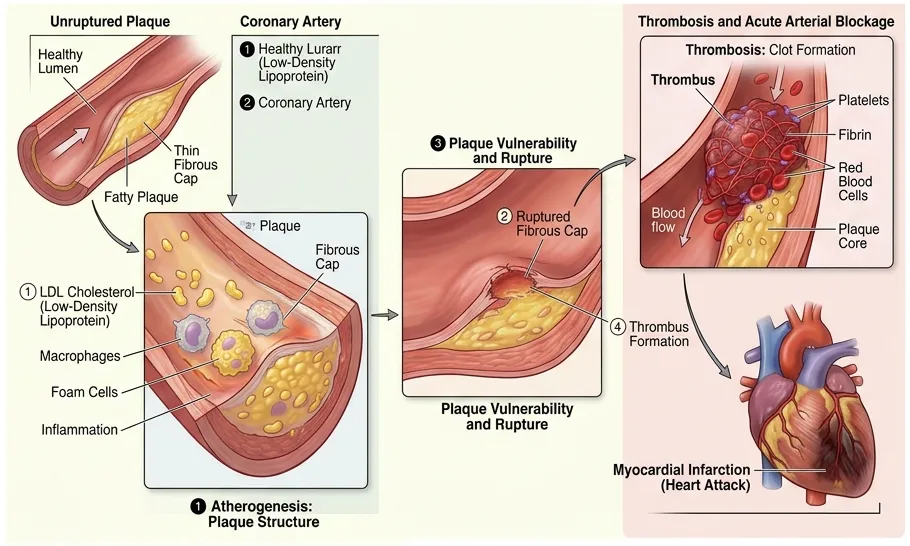
As shown in clinical pathology pathways, the true anatomy of a heart attack involves specific progressive stages:
- Plaque Accumulation: Over decades, excess LDL ("bad") cholesterol penetrates the inner lining of your coronary arteries, building up into an inflamed, waxy deposit known as arterial plaque.
- Cap Rupture: A heart attack is triggered when the thin fibrous cap covering this unstable accumulation suddenly ruptures.
- Thrombosis (Clotting): Your body mistakes this internal rupture for an open vascular wound and rapidly forms a blood clot at the site. This sudden blockage cuts off oxygen to the heart muscle.
| Claim Made in the Article | Accuracy | Clinical & Scientific Fact |
|---|---|---|
| Claim 1: "The body does not manufacture cholesterol as a protective shield during a heart attack." | ACCURATE | True. The body does not produce cholesterol as a targeted "bandage" during a heart attack. While acute trauma or severe physiological stress releases hormones (like cortisol) that can temporarily alter lipid levels in the blood, cholesterol itself is not an emergency defensive secretion. |
| Claim 2: "Excess cholesterol is the primary building block of arterial plaque that causes heart attacks." | ACCURATE | True. Low-Density Lipoprotein (LDL) cholesterol penetrates the endothelium (inner lining of arteries) over time, triggering an inflammatory response that forms atherosclerotic plaque. |
| Claim 3: "A heart attack occurs when the fibrous cap of plaque ruptures, forming a blood clot (thrombosis)." | ACCURATE | True. Plaque buildup narrows arteries over time, but the primary cause of an acute, sudden heart attack is the rupture or erosion of the plaque's fibrous cap. The body forms a thrombus (blood clot) over the rupture, which blocks blood flow to the heart muscle. |
| Claim 4: "Cholesterol-lowering medications like statins help stabilize plaque caps to prevent rupture." | ACCURATE | True. Beyond reducing LDL numbers, statins have "pleiotropic" (secondary beneficial) effects. They reduce inflammation within the artery wall and reinforce the fibrous cap, rendering existing plaque significantly less prone to rupturing. |
| Claim 5: "A small percentage of patients experience muscle aches or side effects on statins." | ACCURATE | True. Large-scale clinical trial data shows that true statin intolerance affects a small minority of patients (around 5–10%), with muscle symptoms (myalgia) being the most reported, usually manageable by adjusting the dosage or switching to a different drug formulation. |
Simply put, cholesterol is the fuel that creates the underlying fire, not the firefighter arriving to put it out.
Weighing the Real Choices: Pros and Cons of Statin Therapy
When patients consider bypassing their cholesterol-lowering medications, they are usually driven by a fear of side effects or a desire to solve the issue strictly through diet. Let us look objectively at the physiological trade-offs involved in managing your vascular health:
🔎 Deep Dive: Explore how these lipid dynamics fit into comprehensive vascular care:
Longevity is a Continuous Journey, Not a Snapshot
Vascular health shifts constantly under the surface, making it dangerous to guess your internal baseline based on internet trends. If you are hesitant about your current prescription due to side effects or conflicting information, do not stop your therapy cold turkey.
Instead, request objective diagnostics. A non-invasive **Coronary Artery Calcium (CAC) scan** or advanced lipid tracking can visually map exactly how much calcified plaque is sitting in your arteries, giving us the precise data needed to customize your dosage, try alternative formulations, or track your long-term cardiovascular baseline safely.
Let's Find Your True Baseline
Stop guessing with unverified health rumors. Whether you want to evaluate your current cardiovascular risk profile or map out a customized strategy for lipid management, we are here to support your long-term cardiac wellness.
Book a Baseline Audit- Singapore Myocardial Infarction Registry (SMIR): Long-term tracking confirms that an overwhelming majority of local heart attack patients exhibit significant, pre-existing metabolic and lipid stressors, validating that plaque accumulation is a key driver of acute cardiac events in Singapore.
- MOH Agency for Care Effectiveness (ACE) Guidelines: Clinical frameworks emphasize aggressive lipid management tailored to individual absolute risk profiles, rather than waiting for structural cardiovascular symptoms to manifest.
- The Lancet Clinical Cohort Diagnostics: Extensive multi-center trials continuously confirm that statin therapies provide profound primary and secondary prevention benefits by altering the core structural composition of vascular plaques, rendering them highly resistant to structural failure.
Medical Disclaimer: This article is for informational purposes only and does not constitute medical advice. Assessing your unique lipid baseline and modifying prescription regimens requires a formal clinical consultation with a qualified physician.