
Overcoming Future Stroke
The Structural Hypertension Audit
⚠️ Did You Know?
53% of Hypertensive Singapore Residents are Undiagnosed.
They feel "fine" because the heart is remarkably resilient. Your heart thickens and remodels to hide the strain. But a remodeled heart is a high-risk heart.
Source: National Population Health Survey (NPHS), Ministry of Health Singapore.1. Your age group:
2. Are you experiencing these signs?
3. Climbing up 2 flights of stairs:
Strategy: Halting Sympathetic Overdrive
In your 20s and 30s, hypertension is often driven by a "hyper-reactive" nervous system. Your audit will focus on whether stress spikes have already triggered early heart thickening. If caught now, medication is often just "temporary scaffolding."
Strategy: Reversing Silent Remodeling
You are in the primary 53% Undiagnosed demographic. Your heart is likely "buffing up" to mask high pressure. If the audit confirms structural changes, medication is mandatory infrastructure repair to prevent a stroke in your next decade.
Strategy: Restoring Vascular Elasticity
When you are above 60, we audit Arterial Stiffness. If your vessels have become "lead pipes," lifestyle alone cannot overcome the stroke risk. Medication is required to soften the "pressure blast" hitting your brain with every beat.
The "Why": Beyond the Number
We do not treat a number on a cuff. We treat the mechanical failure that leads to stroke. The Hypertension Audit inspects your infrastructure for three specific triggers:
- Heart Wall Thickness (LVH): Identifying if your heart muscle has become dangerously thick and stiff.
- Arterial Flexibility: Checking if your "pipes" are still elastic or have turned into rigid, brittle tubes.
- Micro-Vascular Health: Inspecting the kidney and brain "filters" for early pressure-scarring.
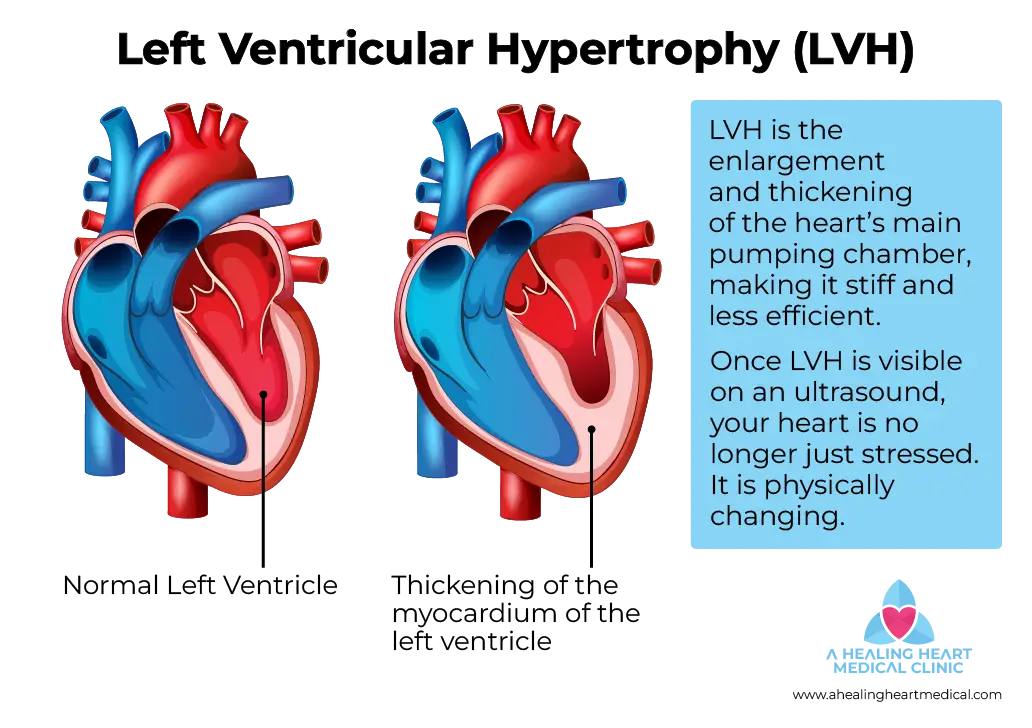
Figure 1: Structural Remodeling: Notice how the heart wall on the right has thickened inward, shrinking the space available for blood. This physical change is why "feeling fine" isn't enough, and why your heart is working harder just to keep up.
Lifestyle Trial vs. Mandatory Medication
To overcome a future stroke, we must be clinical about when to use medication. It is not a failure—it is a tool.
Lifestyle Trial is Viable IF:
Readings are 130-139 / 80-89 AND the Structural Audit confirms zero heart remodeling or arterial stiffening.
Medication is Mandatory IF:
Consistently 140/90+ OR ultrasound shows Remodeling has begun. At this stage, lifestyle changes cannot "un-stiffen" the heart fast enough to bypass stroke risk.
Interpreting Your Readings
| BP Reading Location | Clinical Goal | Why the Difference? |
|---|---|---|
| Home | Below 130/80 |
This is your True Baseline. It removes the variables of travel stress and "White Coat" anxiety.
The Protocol: Take readings twice a day. Once in the morning and once at night. Always measure before meals and before taking your blood pressure medication to capture your body's natural state. |
| Clinic | Below 140/90 | Includes a clinical "buffer" for clinic-induced stress. We look for structural trends here. |
| Portable Ambulatory (24hr) | Average < 130/80 | A personal BP monitoring device that captures your pressure during sleep and daily stress. |
Navigating the Treatment Plan
Address your hesitations with clinical data. We select medication classes based on your Audit results to ensure protection with minimal lifestyle impact:
| Your Concern | Clinical Reality | What this means for you |
|---|---|---|
| "I'll be on it forever" | Medication acts as "scaffolding" to support your daily function. If the heart returns to normal thickness (un-remodeling), dosages can often be tapered. | Medication is a tool for repair, not necessarily a life sentence. |
| "Side effects will ruin my day" | Modern hypertensive medications are designed to be "metabolically neutral." This means you shouldn't feel them at all. | We choose the class that matches your body's chemistry to ensure 100% lifestyle continuity. |
| "It's just White Coat Syndrome" | Spiking in the clinic often means you spike during stress at work. Your heart doesn't know the difference. | If the Audit shows your heart wall is thick, your "White Coat" spikes are already causing physical damage. |
Defeating the "Morning Surge"
The highest risk for stroke occurs between 6:00 AM and 10:00 AM, when your blood pressure naturally spikes to wake you up.
The Strategy: While consistency is key, your medication timing acts as your "scaffolding." We can audit your BP 24-hour cycle to ensure your protection is at its strongest when your risk is at its highest.
Your future is a structural decision.
Hypertension Audit FAQ
Not necessarily. If your audit shows the damage is early and reversible, we use medication as 'temporary scaffolding.' Once your lifestyle stabilizes and the heart wall thins back down, we can often taper the dosage.
In Singapore, high-stress environments and high-sodium diets can trigger hypertension even in the 'genetically lucky.' The audit reveals how your specific body is coping with these modern stressors.
Hypertension is called the "Silent Killer" for a reason. Most people feel absolutely nothing, even when their pressure is at stroke-level.
In Singapore, our salt intake is roughly double the WHO recommendation due to soy sauce, gravies, and processed noodles. Reducing salt can sometimes drop systolic pressure by 5–8 mmHg.
Caffeine causes a temporary spike. We advise not drinking coffee within 30 minutes of a reading, but moderate consumption (1-2 cups) is usually safe for most patients.
Yes. Aerobic exercise makes your heart stronger. However, if your resting BP is above 180/110, consult us before heavy lifting, as it causes sharp, temporary pressure surges.
BP rises sharply just before you wake up. Most strokes occur between 6:00 AM and 10:00 AM. Consistent medication ensures your "scaffolding" is active during this high-risk window.