
A Woman’s Guide to Menopause Bone Health & Heart Protection
Protecting Your Mobility & Heart

By Dr. Gerald Thang
Principal Physician
MBBS (Singapore), MRCP (UK), Graduate Diploma in Cardiology
A woman’s priority is rarely "just managing weight." Her true priority is securing her cardiovascular and mobility future. To achieve this, we must look beyond the scale and address the "Invisible Conflict" that standard screenings often miss.
Bone density loss from optimal health to osteoporosis has no fixed timeline. We focus on women in their mid-40s to early 50s, identifying fluctuating hormone levels as a critical warning sign for proactive management.
1. The Perimenopause Warning: Decoding the "Invisible Conflict"
General advice fails many women because standard tests like BMI often hide a dangerous metabolic reality. You may maintain a "normal" weight externally, yet pack visceral fat deep around your internal organs. This is the TOFI phenotype (Thin on the Outside, Fat on the Inside), typically found among the Asian population.
When estradiol (estrogen) falls during menopause, this visceral fat triggers "Hidden Fire" inflammation. This inflammation doesn't just sit there; it actively "scuffs" your arterial walls and weakens your bone matrix internally. This creates a parallel risk: as your bones become more porous, your heart risk increases.
2. The Three Stages of Bone Porosity
Understanding where you sit on the spectrum allows for definitive clinical stewardship rather than mere observation.
| Stage | Condition | Internal Reality |
|---|---|---|
| 1 | Optimal Health | Dense, interconnected scaffold. Shielded by hormones and a clear metabolic cavity. |
| 2 | Osteopenia | The "Warning Zone." Scaffold thins as visceral inflammation begins to "scuff" the matrix. |
| 3 | Osteoporosis | The "Clinical Threshold." Bone is fragile and full of porous holes. High fracture risk. |
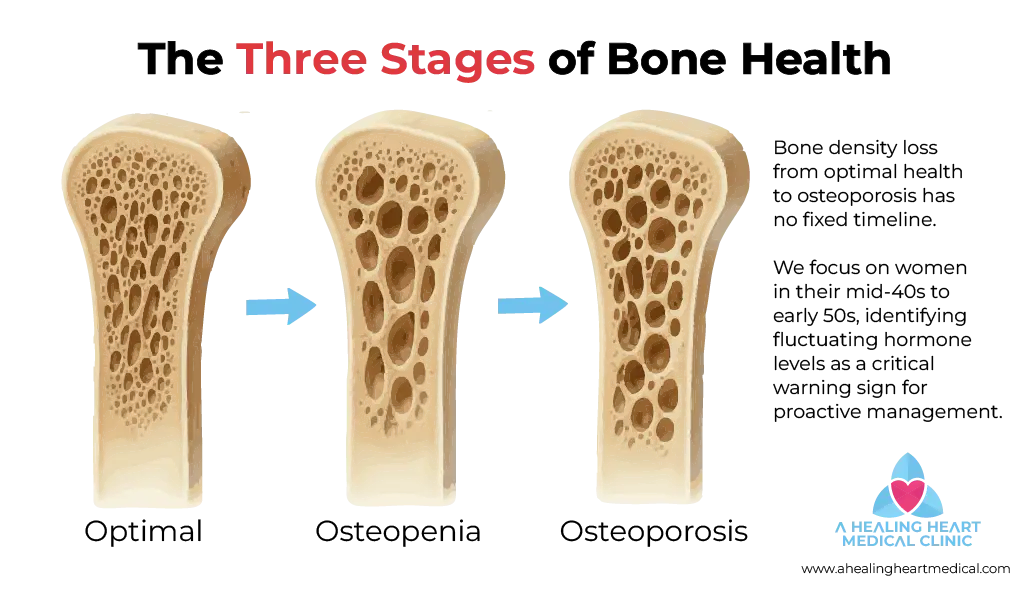
Figure 1: The progression of bone porosity alongside metabolic decline as the "Estrogen Shield" thins.
The Estrogen Shield Timeline
Swipe left to see the full timeline →
| Life Stage | Internal State | The "Golden Timeline" Goal |
|---|---|---|
| 1. Pre-Menopause (Active Shield) |
High estrogen levels act as a natural protector. Your blood vessels stay flexible ("bouncy") and your bones are constantly being rebuilt and strengthened. | Foundation Building: Maximize bone density and keep the "Big Three" (BP, Sugar, Cholesterol) at optimal levels while your body is at its strongest. |
| 2. Perimenopause (The Warning Zone) |
Estrogen begins to fluctuate. This is when "Hidden Fire" inflammation rises, causing vessels to stiffen and bone loss to accelerate. | The Critical Intervention: This is the "Golden Timeline." We must halt the internal "sanding" and "hammering" effects before the bone scaffold thins too much. |
| 3. Menopause (The Shield Drops) |
Estrogen levels stay low. Without the shield, bone porosity increases and heart risks can jump. The body’s ability to "bounce back" slows as the metabolic lock tightens. | Active Shielding: Shifting to "Clinical Stewardship." We focus on protecting remaining bone density and shielding the heart from permanent structural changes. |
3. Proactive Management: Clinical Stewardship
If you are in your mid-40s or 50s, the goal is to move past general observation. At A Healing Heart Medical, we don't just monitor the decline; we audit the underlying drivers of bone and vascular aging to intervene before a crisis occurs.
Don't Wait for a Fracture
Clear the metabolic lock and secure your mobility. Get clinical clarity on your internal health today through a comprehensive Structural Audit.
Book Your Menopause Metabolic AuditFrequently Asked Questions
How long does it take to go from Osteopenia to Osteoporosis?
There is no fixed timeline. Progression depends on your individual metabolic health, inflammation levels, and how quickly hormone levels drop. Proactive management can significantly slow or stop this progression.
Can I have bone loss even if I am thin?
Yes. Many thin women possess high levels of visceral fat (TOFI). This "Hidden Fire" inflammation weakens bones from the inside, regardless of what the weighing scale says. This is why we look beyond the lab report to the actual physical impact on your system.