
The "Red Zones" of Heart Pain Radiation

By Dr. Gerald Thang
Principal Physician
MBBS (Singapore), MRCP (UK), Graduate Diploma in Cardiology
When most people think of a heart attack, they imagine a sharp, crushing pain in the center of the chest. In reality, cardiac distress is often a "master of disguise." It borrows nerve pathways from other parts of the body, sending signals to areas you might never expect.
If you are experiencing discomfort that "travels" or appears during exertion, you aren't dealing with a simple muscle ache, you are seeing a Red Zone signal that needs your attention.
1. Mapping the Red Zones
Heart pain doesn't always stay in the heart. Because the brain sometimes "misinterprets" the source of cardiac distress, you may feel it in these common radiation areas:
- The Left Arm & Shoulder: The classic "heavy," "numb," or "tingling" sensation that can travel all the way to the fingers.
- The Jaw and Teeth: Often mistaken for a dental issue or a "tight" jaw. If your jaw aches only when you walk or exercise, it is likely a heart signal.
- The Back (Between Shoulder Blades): Frequently dismissed as poor posture or a "muscle knot" from the office.
- The Upper Abdomen (The Indigestion Trap): Many patients dismiss cardiac pain as gastric reflux. If antacids don't help, the bottom of your heart may be signaling distress.
- The Neck and Throat: A sensation of choking, pressure, or a "lump" in the throat that persists.
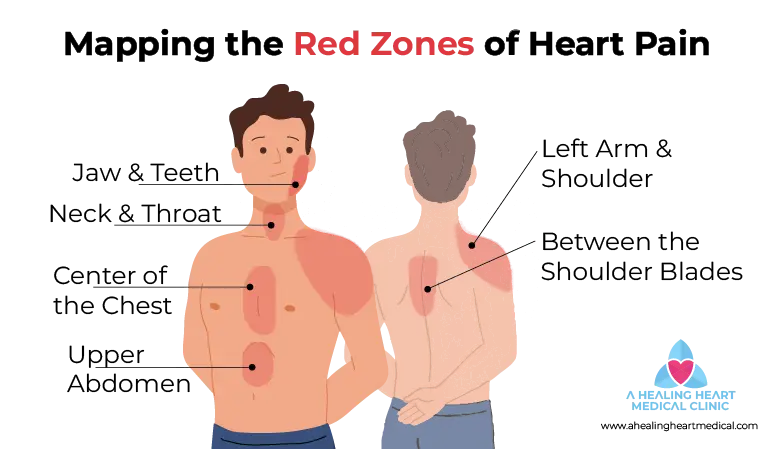
Figure 1: Common areas of referred cardiac pain (The Red Zones).
The "Exertion Test"
The hallmark of cardiac radiation is its relationship to activity. If your jaw, back, or arm begins to ache when you are walking uphill or carrying groceries, but stops when you rest, your heart is sending a distress signal. This is not a "muscle knot" but a vascular warning.
2. Why "Watching It" is Not a Strategy
In our clinic, we often see patients who have spent weeks trying to "rub out" a pain in their shoulder or back, only to find their heart was the true culprit. When pain radiates, the signal is no longer just a risk but a sign that your heart muscle needs attention.
How A Healing Heart Medical Helps:
Rapid Bedside Diagnostics: We don't guess. We work out a comprehensive diagnostics plan to determine within minutes if your pain is coming from your heart or elsewhere.
Identifying the Root Cause: We use a precision audit to see if underlying factors are making your arteries narrow, causing these deceptive radiation signals.
Clinical Stewardship: We provide a personalized roadmap to manage your heart health and protect your heart muscle from permanent damage.
3. A Relatable Heart Connection
If your body is sending signals to your jaw, arm, or back, it is time to stop seeking for a body massage, and start looking at your heart. You don't need to wait for a "big event" to get answers. Move from "witnessing" your symptoms to Clinical Stewardship. We are here to help you decode what your body is saying.
Frequently Asked Questions
Can heart pain feel like a toothache?
Yes. Because the heart and jaw share nerve pathways, cardiac distress can manifest as a dull, heavy ache in the lower jaw or teeth, often triggered by physical activity.
How do I know if it's just indigestion?
If the "burning" in your stomach is accompanied by sweating, shortness of breath, or if it happens when you are active rather than after a heavy meal, treat it as a heart signal.
Is a rapid blood test available for this?
Yes. We use rapid diagnostic markers that can tell us very quickly if your heart muscle is in distress, providing clarity when symptoms are confusing.
Don't Dismiss the Signals
Unexplained pain in the "Red Zones" requires immediate attention. Let us help you find answers to the source of your pain.
Book a Cardiac Review